


Authors: Mia Charifson, PhD; Sara Sauer, PhD; Isabel R. Fulcher, PhD
Background: Current evidence is mixed regarding whether remote blood pressure monitoring (RBPM) effectively improves blood pressure management for prenatal and postpartum patients.
Hypothesis: We hypothesize that RBPM improves timely detection of elevated blood pressure readings in the prenatal and postpartum period, as well as adherence to ACOG postpartum blood pressure guidelines for patients diagnosed with hypertensive disorders of pregnancy (HDP).
Methods: Utilizing electronic health records and patient-collected data from a digital maternal health solution, we compared historical controls who received standard care to patients enrolled in a pregnancy application provided a blood pressure cuff (at provider discretion). Matched cohorts (3:1 match ratio) were generated matching on age, nulliparity, singleton gestation, early gestation (<24 weeks) blood pressure values, preferred language, history of HDP and chronic hypertension, and prenatal clinic. Restricted mean survival time was used to estimate the difference in time to detect first elevated blood pressure value (systolic > 140 mmHg or diastolic > 90 mmHg) between exposure groups and accelerated failure time models were performed to estimate time ratios. Logistic regression estimated the difference in odds of adhering to ACOG postpartum blood pressure guidelines (≥1 reading within 3-10 days postpartum) for postpartum patients diagnosed with HDP.
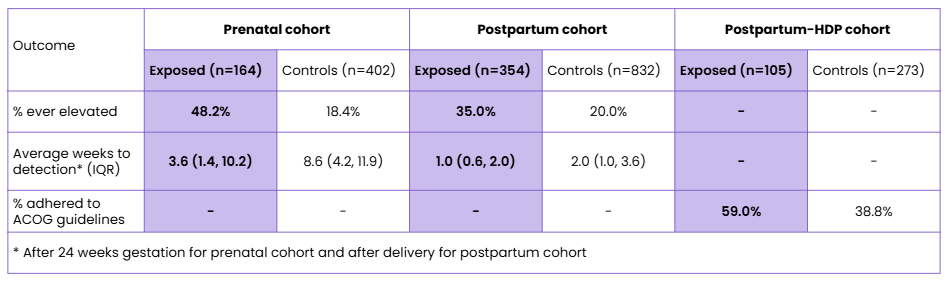
Results: The prenatal cohort consisted of n=566 patients (164 exposed, 402 controls). The restricted mean difference in time to detection was 2.55 weeks earlier for RBPM patients compared with controls, with an average 5 times faster detection (Time Ratio [TR] = 0.22, 95% Confidence Interval [CI]: 0.13, 0.36). In the postpartum period (n=1,186; 354 exposed, 832 controls), RBPM patients detected elevated readings on average 0.97 weeks earlier and 4 times faster (TR=0.27, 95% CI: 0.18, 0.40). Among postpartum patients with HDP (n=378; 105 exposed, 273 controls), RBPM patients had 2.18 higher odds (95% CI: 1.36, 3.48) of adhering to the ACOG postpartum blood pressure guidelines compared with controls.
Conclusion: Compared with the standard of care, we found evidence in this study population that RBPM meaningfully improves time to detection of elevated blood pressure readings in the prenatal and postpartum period, as well as adherence to ACOG blood pressure guidelines for patients diagnosed with HDP. RBPM and associated digital maternal health tools are valuable tools for blood pressure management for pregnant patients and obstetric care teams.
Authors: Mia Charifson, PhD; Sara Sauer, PhD; Isabel R. Fulcher, PhD
Background: Current evidence is mixed regarding whether remote blood pressure monitoring (RBPM) effectively improves blood pressure management for prenatal and postpartum patients.
Hypothesis: We hypothesize that RBPM improves timely detection of elevated blood pressure readings in the prenatal and postpartum period, as well as adherence to ACOG postpartum blood pressure guidelines for patients diagnosed with hypertensive disorders of pregnancy (HDP).
Methods: Utilizing electronic health records and patient-collected data from a digital maternal health solution, we compared historical controls who received standard care to patients enrolled in a pregnancy application provided a blood pressure cuff (at provider discretion). Matched cohorts (3:1 match ratio) were generated matching on age, nulliparity, singleton gestation, early gestation (<24 weeks) blood pressure values, preferred language, history of HDP and chronic hypertension, and prenatal clinic. Restricted mean survival time was used to estimate the difference in time to detect first elevated blood pressure value (systolic > 140 mmHg or diastolic > 90 mmHg) between exposure groups and accelerated failure time models were performed to estimate time ratios. Logistic regression estimated the difference in odds of adhering to ACOG postpartum blood pressure guidelines (≥1 reading within 3-10 days postpartum) for postpartum patients diagnosed with HDP.
Results: The prenatal cohort consisted of n=566 patients (164 exposed, 402 controls). The restricted mean difference in time to detection was 2.55 weeks earlier for RBPM patients compared with controls, with an average 5 times faster detection (Time Ratio [TR] = 0.22, 95% Confidence Interval [CI]: 0.13, 0.36). In the postpartum period (n=1,186; 354 exposed, 832 controls), RBPM patients detected elevated readings on average 0.97 weeks earlier and 4 times faster (TR=0.27, 95% CI: 0.18, 0.40). Among postpartum patients with HDP (n=378; 105 exposed, 273 controls), RBPM patients had 2.18 higher odds (95% CI: 1.36, 3.48) of adhering to the ACOG postpartum blood pressure guidelines compared with controls.
Conclusion: Compared with the standard of care, we found evidence in this study population that RBPM meaningfully improves time to detection of elevated blood pressure readings in the prenatal and postpartum period, as well as adherence to ACOG blood pressure guidelines for patients diagnosed with HDP. RBPM and associated digital maternal health tools are valuable tools for blood pressure management for pregnant patients and obstetric care teams.
Authors: Mia Charifson, PhD; Sara Sauer, PhD; Isabel R. Fulcher, PhD
Background: Current evidence is mixed regarding whether remote blood pressure monitoring (RBPM) effectively improves blood pressure management for prenatal and postpartum patients.
Hypothesis: We hypothesize that RBPM improves timely detection of elevated blood pressure readings in the prenatal and postpartum period, as well as adherence to ACOG postpartum blood pressure guidelines for patients diagnosed with hypertensive disorders of pregnancy (HDP).
Methods: Utilizing electronic health records and patient-collected data from a digital maternal health solution, we compared historical controls who received standard care to patients enrolled in a pregnancy application provided a blood pressure cuff (at provider discretion). Matched cohorts (3:1 match ratio) were generated matching on age, nulliparity, singleton gestation, early gestation (<24 weeks) blood pressure values, preferred language, history of HDP and chronic hypertension, and prenatal clinic. Restricted mean survival time was used to estimate the difference in time to detect first elevated blood pressure value (systolic > 140 mmHg or diastolic > 90 mmHg) between exposure groups and accelerated failure time models were performed to estimate time ratios. Logistic regression estimated the difference in odds of adhering to ACOG postpartum blood pressure guidelines (≥1 reading within 3-10 days postpartum) for postpartum patients diagnosed with HDP.
Results: The prenatal cohort consisted of n=566 patients (164 exposed, 402 controls). The restricted mean difference in time to detection was 2.55 weeks earlier for RBPM patients compared with controls, with an average 5 times faster detection (Time Ratio [TR] = 0.22, 95% Confidence Interval [CI]: 0.13, 0.36). In the postpartum period (n=1,186; 354 exposed, 832 controls), RBPM patients detected elevated readings on average 0.97 weeks earlier and 4 times faster (TR=0.27, 95% CI: 0.18, 0.40). Among postpartum patients with HDP (n=378; 105 exposed, 273 controls), RBPM patients had 2.18 higher odds (95% CI: 1.36, 3.48) of adhering to the ACOG postpartum blood pressure guidelines compared with controls.
Conclusion: Compared with the standard of care, we found evidence in this study population that RBPM meaningfully improves time to detection of elevated blood pressure readings in the prenatal and postpartum period, as well as adherence to ACOG blood pressure guidelines for patients diagnosed with HDP. RBPM and associated digital maternal health tools are valuable tools for blood pressure management for pregnant patients and obstetric care teams.
Authors: Mia Charifson, PhD; Sara Sauer, PhD; Isabel R. Fulcher, PhD
Background: Current evidence is mixed regarding whether remote blood pressure monitoring (RBPM) effectively improves blood pressure management for prenatal and postpartum patients.
Hypothesis: We hypothesize that RBPM improves timely detection of elevated blood pressure readings in the prenatal and postpartum period, as well as adherence to ACOG postpartum blood pressure guidelines for patients diagnosed with hypertensive disorders of pregnancy (HDP).
Methods: Utilizing electronic health records and patient-collected data from a digital maternal health solution, we compared historical controls who received standard care to patients enrolled in a pregnancy application provided a blood pressure cuff (at provider discretion). Matched cohorts (3:1 match ratio) were generated matching on age, nulliparity, singleton gestation, early gestation (<24 weeks) blood pressure values, preferred language, history of HDP and chronic hypertension, and prenatal clinic. Restricted mean survival time was used to estimate the difference in time to detect first elevated blood pressure value (systolic > 140 mmHg or diastolic > 90 mmHg) between exposure groups and accelerated failure time models were performed to estimate time ratios. Logistic regression estimated the difference in odds of adhering to ACOG postpartum blood pressure guidelines (≥1 reading within 3-10 days postpartum) for postpartum patients diagnosed with HDP.
Results: The prenatal cohort consisted of n=566 patients (164 exposed, 402 controls). The restricted mean difference in time to detection was 2.55 weeks earlier for RBPM patients compared with controls, with an average 5 times faster detection (Time Ratio [TR] = 0.22, 95% Confidence Interval [CI]: 0.13, 0.36). In the postpartum period (n=1,186; 354 exposed, 832 controls), RBPM patients detected elevated readings on average 0.97 weeks earlier and 4 times faster (TR=0.27, 95% CI: 0.18, 0.40). Among postpartum patients with HDP (n=378; 105 exposed, 273 controls), RBPM patients had 2.18 higher odds (95% CI: 1.36, 3.48) of adhering to the ACOG postpartum blood pressure guidelines compared with controls.
Conclusion: Compared with the standard of care, we found evidence in this study population that RBPM meaningfully improves time to detection of elevated blood pressure readings in the prenatal and postpartum period, as well as adherence to ACOG blood pressure guidelines for patients diagnosed with HDP. RBPM and associated digital maternal health tools are valuable tools for blood pressure management for pregnant patients and obstetric care teams.
Authors: Mia Charifson, PhD; Sara Sauer, PhD; Isabel R. Fulcher, PhD
Background: Current evidence is mixed regarding whether remote blood pressure monitoring (RBPM) effectively improves blood pressure management for prenatal and postpartum patients.
Hypothesis: We hypothesize that RBPM improves timely detection of elevated blood pressure readings in the prenatal and postpartum period, as well as adherence to ACOG postpartum blood pressure guidelines for patients diagnosed with hypertensive disorders of pregnancy (HDP).
Methods: Utilizing electronic health records and patient-collected data from a digital maternal health solution, we compared historical controls who received standard care to patients enrolled in a pregnancy application provided a blood pressure cuff (at provider discretion). Matched cohorts (3:1 match ratio) were generated matching on age, nulliparity, singleton gestation, early gestation (<24 weeks) blood pressure values, preferred language, history of HDP and chronic hypertension, and prenatal clinic. Restricted mean survival time was used to estimate the difference in time to detect first elevated blood pressure value (systolic > 140 mmHg or diastolic > 90 mmHg) between exposure groups and accelerated failure time models were performed to estimate time ratios. Logistic regression estimated the difference in odds of adhering to ACOG postpartum blood pressure guidelines (≥1 reading within 3-10 days postpartum) for postpartum patients diagnosed with HDP.
Results: The prenatal cohort consisted of n=566 patients (164 exposed, 402 controls). The restricted mean difference in time to detection was 2.55 weeks earlier for RBPM patients compared with controls, with an average 5 times faster detection (Time Ratio [TR] = 0.22, 95% Confidence Interval [CI]: 0.13, 0.36). In the postpartum period (n=1,186; 354 exposed, 832 controls), RBPM patients detected elevated readings on average 0.97 weeks earlier and 4 times faster (TR=0.27, 95% CI: 0.18, 0.40). Among postpartum patients with HDP (n=378; 105 exposed, 273 controls), RBPM patients had 2.18 higher odds (95% CI: 1.36, 3.48) of adhering to the ACOG postpartum blood pressure guidelines compared with controls.
Conclusion: Compared with the standard of care, we found evidence in this study population that RBPM meaningfully improves time to detection of elevated blood pressure readings in the prenatal and postpartum period, as well as adherence to ACOG blood pressure guidelines for patients diagnosed with HDP. RBPM and associated digital maternal health tools are valuable tools for blood pressure management for pregnant patients and obstetric care teams.
Authors: Mia Charifson, PhD; Sara Sauer, PhD; Isabel R. Fulcher, PhD
Background: Current evidence is mixed regarding whether remote blood pressure monitoring (RBPM) effectively improves blood pressure management for prenatal and postpartum patients.
Hypothesis: We hypothesize that RBPM improves timely detection of elevated blood pressure readings in the prenatal and postpartum period, as well as adherence to ACOG postpartum blood pressure guidelines for patients diagnosed with hypertensive disorders of pregnancy (HDP).
Methods: Utilizing electronic health records and patient-collected data from a digital maternal health solution, we compared historical controls who received standard care to patients enrolled in a pregnancy application provided a blood pressure cuff (at provider discretion). Matched cohorts (3:1 match ratio) were generated matching on age, nulliparity, singleton gestation, early gestation (<24 weeks) blood pressure values, preferred language, history of HDP and chronic hypertension, and prenatal clinic. Restricted mean survival time was used to estimate the difference in time to detect first elevated blood pressure value (systolic > 140 mmHg or diastolic > 90 mmHg) between exposure groups and accelerated failure time models were performed to estimate time ratios. Logistic regression estimated the difference in odds of adhering to ACOG postpartum blood pressure guidelines (≥1 reading within 3-10 days postpartum) for postpartum patients diagnosed with HDP.
Results: The prenatal cohort consisted of n=566 patients (164 exposed, 402 controls). The restricted mean difference in time to detection was 2.55 weeks earlier for RBPM patients compared with controls, with an average 5 times faster detection (Time Ratio [TR] = 0.22, 95% Confidence Interval [CI]: 0.13, 0.36). In the postpartum period (n=1,186; 354 exposed, 832 controls), RBPM patients detected elevated readings on average 0.97 weeks earlier and 4 times faster (TR=0.27, 95% CI: 0.18, 0.40). Among postpartum patients with HDP (n=378; 105 exposed, 273 controls), RBPM patients had 2.18 higher odds (95% CI: 1.36, 3.48) of adhering to the ACOG postpartum blood pressure guidelines compared with controls.
Conclusion: Compared with the standard of care, we found evidence in this study population that RBPM meaningfully improves time to detection of elevated blood pressure readings in the prenatal and postpartum period, as well as adherence to ACOG blood pressure guidelines for patients diagnosed with HDP. RBPM and associated digital maternal health tools are valuable tools for blood pressure management for pregnant patients and obstetric care teams.